
How to Find Meaningful Images for Your Vision Board (Not Just Pretty Ones)
In 1988, a woman sat in her apartment and wrote something in her personal journal. Not a grocery list. Not a diary entry. She wrote a series of prose affirmations, statements about the future she wanted, described as if they had already happened. She wrote about the books she would publish. The recognition she would earn. The life she would build.
Her name was Octavia E. Butler. She became the first science fiction writer to receive a MacArthur “Genius” Fellowship. And those journal entries? Scholars now consider them among the earliest known examples of what we’d call vision board principles.
Here’s the thing, though. Octavia didn’t paste a generic picture of a bestseller list on a poster board. She didn’t clip a photo of a mansion from a magazine. She wrote about her work. Her voice. Her specific, deeply personal vision of what success meant for her.
And that’s exactly the problem with most vision boards today.
We fill them with beautiful images that mean absolutely nothing to us.
This article is going to show you, backed by actual neuroscience and psychology research, why the images on your vision board matter far more than you think, why “pretty” is almost never enough, and exactly how to find images that will actually move you toward the life you want.
The Vision Board Problem Nobody Talks About
A Quick Foundation
A vision board is a collage of images, photographs, and affirmations representing your goals and desires. They’ve been around, in various forms, for decades. Napoleon Hill laid the groundwork for vision-based goal setting back in 1937 with Think and Grow Rich. Dr. Maxwell Maltz pushed visualization techniques further in 1960 with Psycho-Cybernetics. Soviet athletes were using systematic mental imagery after the 1984 Olympics.
But the modern vision board, the poster board, the magazine clippings, the glue sticks, exploded into the mainstream in 2006 and 2007, when Rhonda Byrne released The Secret as both a film and a book. That book sold over 30 million copies in more than 50 languages. The film and book grossed $300 million by 2009.
And when Oprah Winfrey featured it on two episodes of her show in early 2007, it was over. Vision boards went from niche self-help practice to cultural phenomenon overnight. Simon & Schuster ordered a 2-million-copy second printing, which was reportedly the biggest in the publisher’s history.
Today, the hashtag #VisionBoard has accumulated over 2.5 billion views on TikTok alone. Pinterest, which functions as essentially the world’s largest digital vision board, has 570 million monthly active users, saving 1.5 billion pins per week to over 10 billion boards.
So people are doing this. A lot of people.
But here’s the question nobody seems to be asking: are the images on these boards actually doing anything?
The Pretty Picture Trap

Life coach and Harvard-trained sociologist Martha Beck went looking at vision board software sites and found something interesting. The pre-loaded image libraries were full of, and I want you to picture this, palm trees, beaches, fast cars, dollar signs, and photos of beautiful women. The same aspirational stock imagery you’d find in a luxury car ad or a resort brochure.
Beck’s reaction was blunt. She warned that if we let our surface-level desires run the show, we end up with a board that’s loaded with flashy imagery but completely empty of real purpose and emotion. And a board like that, she said, isn’t going to attract much of anything except dust on a shelf.
Think about that for a second.
How many vision boards have you seen, or maybe even made, that look like a mood board for a lifestyle brand? Flat lay aesthetics. Neutral tones. A latte. A pair of running shoes. A passport on a marble countertop. It’s gorgeous. It looks incredible on Instagram.
But does it actually mean anything to you?
I’m going to call this the Pretty Picture Trap. And it’s backed by some genuinely fascinating science about why your brain treats a generic beautiful image completely differently from a personally meaningful one.
Why Your Brain Doesn’t Care About Stock Photos
Here’s where the neuroscience gets really interesting.
Researchers at NYU, Vessel and colleagues, in 2012, used fMRI brain imaging and found that the medial prefrontal cortex, the brain region responsible for self-referential processing, responds selectively to aesthetic experiences that are personally relevant and carry strong emotional content.
In plain language: your brain literally activates differently when you look at something that connects to your identity versus something that’s just generically attractive. A gorgeous sunset photo might produce a brief “oh, nice” response. But a photo of the specific trail where you and your best friend hiked during the hardest year of your life? That lights up a completely different part of your brain.
And this tracks with a landmark 1992 study by Ruvolo and Markus, published in Social Cognition. They found that subjects who imagined themselves being successful in the future performed better on tasks involving effort and persistence, compared not only to people who imagined failure, but also to people who received generic positive mood induction. In other words: self-relevant future imagery was more effective than just feeling good.
The image needs to be about you. Not about a lifestyle. Not about an aesthetic. About you.
The Science of Why Meaningful Images Work
Your Brain Can’t Tell the Difference (Sort Of)
Multiple fMRI studies have confirmed that mental imagery activates the same neural pathways as actual physical action. Lotze and colleagues, publishing in the Journal of Cognitive Neuroscience in 1999, showed that the supplementary motor area, premotor cortex, and even the primary motor cortex all activate during both executed and imagined hand movements. Research suggests somewhere between 60 and 80 percent overlap in brain activation between imagery and actual execution.
That’s not a small number. That’s your brain essentially rehearsing reality.
Now, this doesn’t mean staring at a picture of a Ferrari will make one appear in your driveway. What it means is that when you regularly look at images that represent your goals and future self, your brain is, in a real neurological sense, practicing for that future.
But, and this is the critical “but,” the research is very specific about what kind of imagery actually works.
Process Versus Outcome: The Study That Changes Everything
In 1999, researchers Pham and Taylor at UCLA ran what I think is one of the most important studies for anyone building a vision board.
They took college freshmen before a midterm exam and split them into groups. One group mentally simulated the outcome, getting a great grade, seeing the A on the paper, feeling proud. Another group mentally simulated the process, visualizing when, where, and how they would study. Sitting at the desk. Opening the textbook. Working through practice problems.
The results were striking.
The students who visualized the process started studying earlier, studied more hours, and scored approximately 8 points higher than the outcome-only group. The outcome-only group? They performed no better than the control group that didn’t visualize at all.
Sit with that for a moment. Visualizing only the end result, the dream house, the ideal body, the fat bank account, did not improve performance. What improved performance was visualizing the daily actions it would take to get there.
And here’s where this directly applies to your vision board: if your board is nothing but glamorous end-state images, the beach house, the sports car, the corner office, you might actually be undermining your own motivation.
The Fantasy Trap: When Dreaming Makes You Do Less
This is where psychologist Gabriele Oettingen’s work at NYU becomes essential reading for anyone serious about vision boards.
Across multiple studies over more than 20 years, Oettingen and her colleagues have demonstrated something that sounds almost counterintuitive: the more positively people fantasize about their desired future, the worse they perform at actually achieving it.
In one early study, published in Cognitive Therapy and Research in 1991, she found that the more positively overweight women fantasized about losing weight, the fewer pounds they actually lost over one year. In 2002, she and Mayer showed across four domains, job seeking, romance, exams, and surgery recovery, that positive expectations predicted better outcomes, but positive fantasies predicted worse outcomes with lower effort.
Then in 2011, Kappes and Oettingen published a study in the Journal of Experimental Social Psychology with four experiments showing that positive fantasies about the future led to lower systolic blood pressure, which sounds nice but is actually a marker of reduced energization, along with lower self-reported energy and less effort.
Here’s how Oettingen explains the mechanism: when you vividly imagine a wonderful future, your brain partially experiences it as already real. And if some part of you feels like you’ve already arrived? The urgency to act evaporates.
As she put it directly: the more positively people fantasize or daydream about the future, the less well they do in trying to make it real.
Does this mean vision boards are useless? No. What it means is that a vision board filled only with dreamy outcome images, without any connection to effort, obstacles, and the real work of getting there, can actually become a subtle form of self-sabotage.
The Fix: Mental Contrasting
Oettingen’s research didn’t stop at the problem. She developed a solution, a technique called Mental Contrasting, formalized in her book Rethinking Positive Thinking, published by Penguin in 2014.
The idea is simple but powerful. Instead of just fantasizing about the desired future, you fantasize about the desired future and then deliberately reflect on the obstacles in your present reality that stand in the way.
She put it perfectly: the solution isn’t to abandon dreaming and positive thinking. It’s to make the most of our fantasies by confronting them with the very obstacles most of us are taught to ignore.
Only this combination, imagining the best outcome, then honestly facing the obstacles, produced what she calls “expectancy-dependent commitment.” That means high motivation when the goal is actually feasible, and the wisdom to disengage when it’s not.
She even turned this into a practical method called WOOP: Wish, Outcome, Obstacle, Plan. It’s been validated across health behavior, academic performance, relationships, and more.
For your vision board, this means something very practical: you need images that represent the obstacles, the process, and the daily grind, not just the finish line.
How to Know If an Image Is “Meaningful”

The Self-Concordance Test
How do you actually tell the difference between an image that’s just pretty and one that’s genuinely meaningful?
The first test comes from researchers Sheldon and Elliot, who published a study in the Journal of Personality and Social Psychology in 1999 on what they called self-concordance, the degree to which your goals align with your developing interests and core values, reflecting autonomous motivation rather than external pressure.
Across three studies, they found that self-concordant goals produced more sustained effort, were more attainable, and led to increased well-being. Goals driven by external pressure or guilt? They generated initial effort but faded quickly.
Translated for your vision board: before you glue anything down, ask yourself. Is this image representing something I genuinely want? Or something I think I should want?
There is a massive difference between wanting to run a marathon because the idea of crossing that finish line makes your chest swell with excitement, and wanting to run a marathon because marathon runners seem impressive and you feel like you should be the kind of person who does that.
The first is self-concordant. The second is what Self-Determination Theory, the framework developed by Edward Deci and Richard Ryan, would call an extrinsic goal driven by external validation. And their research shows that extrinsic goals like financial success, appearance, and status are associated with lower wellness, while intrinsic goals like community, personal growth, and meaningful relationships predict enhanced learning, performance, creativity, and psychological well-being.
So a picture of a Lamborghini on your vision board isn’t automatically wrong. But it’s only meaningful if it genuinely represents something that lights you up from the inside, not something you saw on someone else’s board and thought “I guess I should want that too.”
The Body Test
Here’s my favorite practical technique, and it comes from Martha Beck.
She calls it the body-awareness approach. The idea: relax, stand in front of your potential images, and this is key, squint your eyes so you can’t read any words. Respond only to the visual and emotional resonance.
Notice how your body reacts. Many people will lean toward images that feel right. Others might feel a warmth in their chest, a quickening of their pulse, or what one therapist described as “a felt sense,” an embodied signal from physical sensation.
This approach has neurological backing. Antonio Damasio’s somatic marker hypothesis established that our bodies send physical signals, changes in skin conductance, muscle tension, subtle shifts in posture, that guide decisions before conscious reasoning even engages. Your gut reaction to an image is not random noise. It’s data.
Sakuraco Bryant, a Bullet Journal Certified Trainer, put it simply: her test for whether an image belongs on her board is whether it gives her butterflies every time she glances at it.
If you look at an image and feel nothing, even if it’s objectively beautiful, it doesn’t belong on your board.
The Values Alignment Check
Here’s a more structured approach, and it comes from clinical psychology.
In Acceptance and Commitment Therapy, or ACT, developed by Steven C. Hayes back in 1982, values clarification is a cornerstone. The idea is that values serve as a compass for meaningful living. Not goals, which are things you achieve and check off. Values, which are ongoing directions you travel in.
One of the most widely used tools in this space is the Personal Values Card Sort, developed by W.R. Miller and colleagues at the University of New Mexico in 2011. It’s simple: you sort through 80 or more values, things like creativity, adventure, family, honesty, justice, humor, independence, and rank them into categories like “very important,” “important,” and “not important” until you’ve identified your top three to five core values.
Therapist and board-certified coach Brenda Bomgardner explicitly connects this to vision boards: she says values card sort results can be used directly to create vision boards or mind maps.
Once you know your core values, they become your filter. Every image goes through the test: Does this image represent one of my core values in action?
If your core value is “connection” and you’ve pasted a photo of a luxury apartment where you’d live alone, that’s a mismatch. But a photo of a long dinner table with mismatched chairs and friends laughing? That’s connection in action.
The Art Therapist’s Framework
Chandra Davis is a board-certified art therapist who wrote a detailed guide to vision boards for Psychology Today in December 2025. And her framework is genuinely one of the most thoughtful I’ve encountered.
She distinguishes between goals and intentions. Goals are focused on achievement, like getting the promotion, buying the house, losing 20 pounds. Intentions are about alignment with internal values, things like cultivating ease, practicing creativity, nurturing connection, embodying vitality.
A meaningful vision board, Davis argues, includes how you want to feel in daily life, not just what you want to achieve. She describes a vision board not as a collage of goals, but as a curated visual story, one woven from desire, self-knowledge, memory, and possibility. What you choose, what you leave out, how images relate to each other, even how the board feels as you assemble it, all of it carries meaning.
She recommends sitting with a central question before you start searching for any images at all: What is the story I want to tell about my future? Including what you’re longing for, what you’re actively healing, and what you’re wanting to cultivate.
That’s a fundamentally different starting point than “let me open Pinterest and see what looks cool.”
The Practical Guide: Finding Your Images
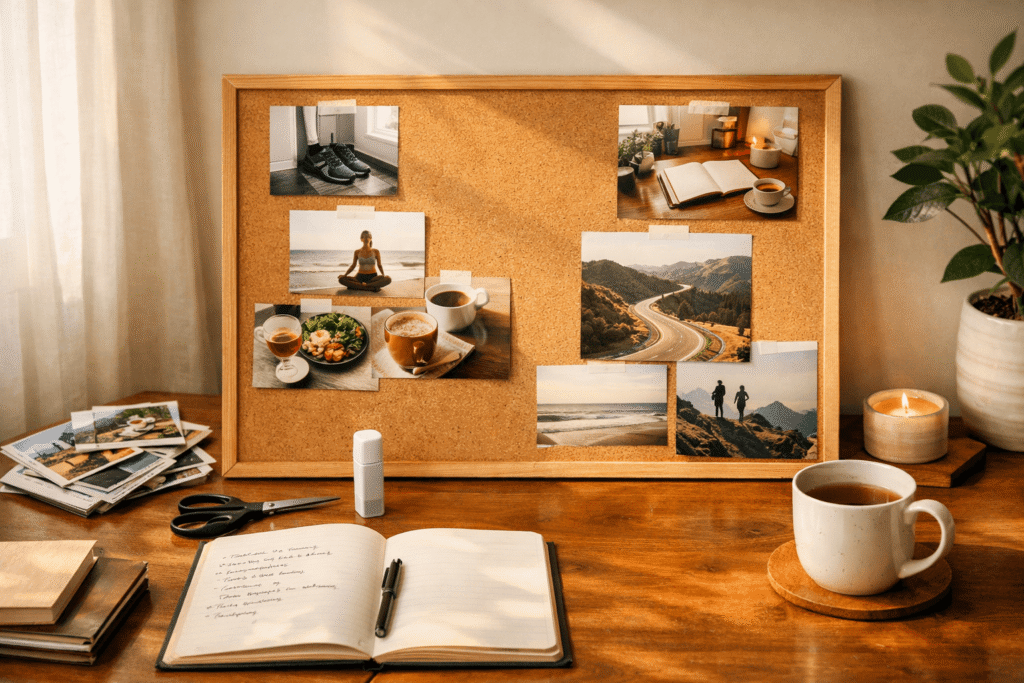
Step 1: Reflect Before You Search
Every expert I encountered in this research said the same thing: do the inner work before you open a single browser tab.
Here are the specific exercises, ranked from fastest to deepest:
The Brain Dump. Jean Haner, writing for Artful Parent, recommends the simplest version: write down every goal, wish, dream, and intention that comes to mind. No filter. No judgment. Fill the page. Then go back and circle the ones you really, truly want above all else. Not the ones that sound impressive. The ones that make your heart beat faster.
The Wheel of Life Assessment. This goes back to Paul J. Meyer in the 1960s. You rate eight to ten life areas, health, career, finances, relationships, personal growth, fun, environment, spirituality, on a scale of 1 to 10. Where you score lowest reveals where you have the most desire for change. Those low-scoring areas deserve the most real estate on your board.
The Values Card Sort. I mentioned this earlier. Identify your top three to five core values. Then for each value, brainstorm what that value looks like when it’s alive in your daily life. Not as an abstraction. As lived experience.
The ACT “Bull’s Eye” exercise. Referenced in Russ Harris’s ACT Made Simple: divide your life into four domains, work or education, leisure, relationships, and personal growth or health, then rate how closely you’re currently living to your values in each area. The biggest gaps become your board’s priorities.
Chandra Davis’s central question. Sit with: “What is the story I want to tell about my future?” Don’t answer immediately. Let it percolate. Journal on it. Sleep on it. The images that matter will start to surface naturally.
Step 2: Use the Feeling Filter, Not the Aesthetic Filter
This is the single most important shift in how you select images.
The coaching team at SelfMadeLadies put it perfectly: instead of focusing on the perfect aesthetic, concentrate on how images make you feel. Their example: when choosing images related to your dream home, focus on how you want to feel when you walk through the door. Whichever image evokes that feeling is the one to choose.
Maybe your dream home doesn’t look like a Restoration Hardware catalog. Maybe it looks like a cluttered kitchen with flour on the counter and a kid’s drawing on the fridge. If that image makes you feel the warmth and aliveness you’re actually craving, it’s a more powerful vision board image than the most stunning architectural photograph in the world.
A friend of mine made a vision board last January, and the image she says she looks at most isn’t a beach or a dream kitchen. It’s a photo she took of her daughter’s boots by the front door on a snow day. She told me it represents everything she’s actually working toward.
Martha Beck takes this a step further. She recommends a physical squinting technique: blur your vision so you can’t read any text, and let your body respond purely to color, composition, and feeling. The images you lean toward physically, the ones that produce warmth, excitement, or longing, those are your keepers.
VLH Health recommends curating slowly. Only add images that feel like an unambiguous “yes” in your body. If you’re debating whether to include something, that debate is your answer.
Step 3: Include Process Images, Not Just Outcome Images
Remember the Pham and Taylor study? Process visualization outperformed outcome visualization by a significant margin.
Sakuraco Bryant discovered this firsthand. When she was building a vision board about writing a magazine column, she initially searched for images of published magazine pages and bylines. But those images felt flat to her. They weren’t personal enough, and they only depicted the extrinsic reward, failing to kindle her intrinsic motivation.
What changed everything? She added images of her actual workspace. Her favorite notebook. A cup of tea at her writing desk. The process of writing, not just the product of having written. She described that shift as a game changer.
So for every outcome image on your board, consider adding a companion process image. Want to run a marathon? Include a photo of your actual running shoes by your actual front door at 6 AM. Want to write a book? Include an image of the cafe where you love to write, or a photo of a messy first draft covered in red ink. Want to build a business? Include an image of someone on a phone call, or a whiteboard covered in scribbled ideas.
This is what bridges the gap between fantasy and motivation. It tells your brain: this is the work, and I’m ready for it.
Step 4: Add Obstacle Awareness
This is the vision board advice almost nobody gives, and it comes directly from Gabriele Oettingen’s research on mental contrasting.
Your board should acknowledge what stands between you and your goals. Not in a defeatist way, but in a clear-eyed, strategic way. An image of an alarm clock if your obstacle is discipline. An image of a challenging conversation if your obstacle is a relationship you need to repair. A photo of a winding road if your obstacle is patience.
This transforms your board from a fantasy document into what it should be: a navigation tool. The combination of aspiration plus obstacle awareness is what Oettingen’s research shows produces the most adaptive, resilient motivation.
Step 5: Go Beyond Stock Imagery
Here’s where to actually find meaningful images:
Your own camera roll. Multiple experts emphasize personal photographs as the most emotionally powerful source material. As published in Current Psychology in 2023, personal photographs were more effective at evoking specific positive autobiographical memories and facilitated the highest level of memory reliving compared to standardized emotional images. Your phone is full of images that already carry deep personal meaning. Use them.
Hand-made elements. Chandra Davis specifically recommends including images created by your own hand, drawings, handwritten words, designs. The act of creating makes the image inherently personal.
Digital libraries for specific searches. Unsplash, Pexels, and Flickr Creative Commons are all excellent free sources when you’re searching for something precise that you don’t have a personal photo of. The key is to search with feeling-based terms, not generic ones. Don’t search “success.” Search “morning light on a desk” or “two friends laughing on a trail” or “hands covered in pottery clay.”
AI image generation. This is a genuinely new development. Tools like Canva’s Magic Studio, Adobe Firefly, and dedicated platforms like VisionBoardsAI can generate custom images based on text prompts, allowing you to create visuals of very specific, personal scenarios that no stock photo library would ever contain.
Meaningful objects photographed. Photograph your grandmother’s ring. Your child’s handwriting. The view from the window of the apartment you’re saving for. A napkin sketch of the business idea you can’t stop thinking about. These carry more emotional weight than any polished professional image.
Step 6: Curate Ruthlessly
More is not better. VLH Health recommends 10 to 20 meaningful visuals per board. That’s it.
Shay Michelle Studios emphasizes the importance of white space, calm areas where not a lot is going on, giving the eye a place to rest. A cluttered board overwhelms the brain. A curated board focuses it.
Every single image earns its place by passing three tests: Does it represent my values? Does it trigger a genuine emotional response in my body? Would I be excited to see this image first thing every morning?
If the answer to any of those is no, or even “maybe,” it doesn’t make the cut.
The Bigger Picture: What the Research Actually Says
Let me be honest about something, because I think honesty serves you better than hype.
There are no rigorous randomized controlled trials that specifically test “vision boards” as a unified intervention. The scientific support I’ve shared here is assembled from adjacent research on visualization, mental imagery, goal-setting, self-concordance, and self-regulation. That research is real, it’s peer-reviewed, and it’s robust. But nobody has run a gold-standard study where they gave one group a vision board and another group nothing and tracked outcomes for a year.
What we do have is this: a 2016 study by Burton and Lent, published in the Journal of Creativity in Mental Health, established vision boards as a legitimate therapeutic intervention. Therapists are using them with everyone from chronic pain patients to military populations to adolescent career counseling programs. The American Counseling Association published a feature on vision boards in clinical practice as recently as 2025.
And we have the TD Bank survey from 2016, conducted by the research firm Vision Critical with over 1,600 participants, which found that people who keep images of their goals are almost twice as confident they’ll achieve them compared to those who don’t. Among small business owners who used vision boards since startup, 82 percent said they’d accomplished more than half their goals. That’s a corporate-commissioned survey, so take the exact numbers with appropriate context. But the pattern is consistent with what the goal-setting research shows.
We also know, from Dr. Gail Matthews’s study at Dominican University, that people who wrote down their goals were 42 percent more likely to achieve them than people who merely thought about them. And the group that wrote goals, shared them with a friend, and sent weekly progress reports? Over 70 percent achieved their goals, compared to 35 percent in the control group.
My brother-in-law actually tried this after I told him about the Matthews study. He texted his goals to a friend every Monday morning for three months. He said the accountability alone changed more than the vision board did.
Vision boards sit at the intersection of all of this: written goals, visual reinforcement, emotional connection, and regular review. The science strongly suggests this intersection is a powerful place to be, if you build the board with intention rather than aesthetics.
The Real Danger of the Pretty Board
Brené Brown, research professor at the University of Texas at Austin, has a quote I keep coming back to. She says authenticity is the daily practice of letting go of who we think we’re supposed to be and embracing who we are.
That’s the real danger of a vision board filled with pretty but meaningless images. It becomes a collage of who you think you’re supposed to be. The life you think you should want. The goals that sound impressive at a dinner party.
And every time you look at it, you’re not reinforcing your authentic self. You’re reinforcing a performance.
A meaningful vision board, one built on genuine values, emotional truth, process imagery, and obstacle awareness, does the opposite. It says: This is who I actually am. This is what I actually want. And this is the work I’m willing to do to get there.
That is an extraordinarily powerful thing to see every single day.
Start Here
Before you touch a pair of scissors, before you open Canva, before you scroll Pinterest for even thirty seconds, take out a blank piece of paper and answer one question.
It’s Chandra Davis’s question, and it’s the only starting point that matters:
What is the story I want to tell about my future?
Not the Instagram version of the story. Not the version your parents would be proud of. Not the version that gets the most likes. The real story. The one that includes the mess, and the growth, and the quiet Tuesday mornings that nobody photographs.
Write that story. Feel it in your body. Identify the values underneath it.
Then go find your images.
Because here’s what Octavia Butler understood in 1988, what the neuroscience confirms, and what every honest coach and therapist will tell you: the images that change your life aren’t the ones that look the best. They’re the ones that feel the most true.
I remember reading about Butler’s journals for the first time a few years ago, and the thing that stuck with me wasn’t the ambition. It was how specific she was. She wasn’t dreaming in generalities. She was describing a life only she could live.