
What a Vision Board Is Really For: The Science Behind Why Most People Use Them Wrong
In 1995, a guy named John Assaraf sat down at his kitchen table with a poster board, a stack of old magazines, and a pair of scissors. He cut out a photo of a house, a gorgeous estate he found in Dream Homes magazine. He didn’t know where the house was. He didn’t know how much it cost. He just thought, that’s the one, and glued it to his board.
Then he packed everything up. Moved three times. Five years went by.
In May of 2000, he’s finally settled in a new home in Southern California, a place he’d bought and renovated. His five-year-old son, Keenan, is sitting on some moving boxes in his office and asks, “Daddy, what’s in these boxes?”
They crack one open. Inside are his old vision boards. And when Assaraf pulls out the second board, he starts to cry.
Because the photo on the board, the dream house from 1995, wasn’t a house like his new home.
It was his house. The exact same property. Seven thousand square feet on six acres, three-thousand-square-foot guest house, tennis court, 320 orange trees. He’d bought his dream home, renovated it, and didn’t even know it.
That story went massively viral when it was featured in a little film called The Secret in 2006. And it’s the reason millions of people started making vision boards.
But here’s the thing nobody tells you about that story, and about vision boards in general.
There’s a version of vision boards that actually works, backed by neuroscience, psychology, and decades of research. And there’s a version that not only doesn’t work, but according to peer-reviewed studies, literally drains your energy and makes you less likely to achieve your goals. This article breaks down exactly which is which, and more importantly, what a vision board is really for.
Where Vision Boards Actually Come From
Before we talk about whether vision boards work, we need to understand where this whole idea came from. Because the history is wilder and more layered than most people realize.

The Positive Thinking Pipeline
The concept of visualizing what you want and then getting it did not start with Pinterest boards and magazine clippings. It started more than a hundred years ago.
In 1910, a man named Wallace D. Wattles published a short book called The Science of Getting Rich. It laid out the idea that you could form a clear mental picture of what you wanted, hold it in your mind, and take action toward it, and the universe would arrange itself to help you. It was the first real articulation of what people now call “creative visualization.”
That book is important for one specific reason: decades later, an Australian television producer named Rhonda Byrne was going through a devastating personal crisis. Her daughter handed her Wattles’ book. And Byrne said it changed everything. That book became the direct inspiration for The Secret.
But between 1910 and 2006, a lot happened.
In 1937, Napoleon Hill published Think and Grow Rich, one of the best-selling self-help books in history with over 100 million copies sold. Hill introduced the idea that “whatever the mind can conceive and believe, it can achieve.” He built an entire system around mental visualization, autosuggestion, and what he called the “Imagination” principle.
Then in 1952, a minister named Norman Vincent Peale published The Power of Positive Thinking. It spent 186 weeks on the New York Times bestseller list, with 48 of those weeks at number one. Sold over five million copies, translated into more than 40 languages. Peale combined Christian spirituality with psychological principles, and he made the idea of positive visualization feel like both a spiritual practice and a practical strategy.
In 1960, a cosmetic surgeon, not a psychologist but a cosmetic surgeon, named Maxwell Maltz noticed something strange about his patients. After successful surgery, some patients still “saw” their old face in the mirror. Their self-image hadn’t caught up to reality. This observation led him to write Psycho-Cybernetics, which sold over 35 million copies and argued that your self-image is like a thermostat, that it determines the upper limit of what you’ll allow yourself to achieve. And the way to change it? Mental rehearsal. Visualization.
Then in 1978, Shakti Gawain published Creative Visualization and introduced the concept of “treasure maps,” which were physical collages of your desired future. That’s probably the closest ancestor to what we now call a vision board.
So by the time Jim Carrey writes himself a check for ten million dollars in 1985, and John Assaraf cuts out a photo of a mansion in 1995, and The Secret drops in 2006, the cultural infrastructure for vision boards had been building for nearly a century.
How The Secret Changed Everything
2006 is when everything went mainstream.
The Secret film premiered online on March 23, 2006. The book followed on November 28th of that year. And then in February 2007, Rhonda Byrne appeared on The Oprah Winfrey Show, not once, but twice. Oprah said the message of The Secret was what she’d been trying to share for 21 years.
The effect was nuclear. As Simon & Schuster’s own sales data shows, by March 2007, both the book and the DVD were the number one sellers at Amazon, Barnes & Noble, and Borders. The book has since sold over 30 million copies worldwide, translated into 50 languages. By 2009, The Secret franchise had grossed over $300 million in combined sales.
And embedded in The Secret was a three-step formula: Ask. Believe. Receive. Also known as the Law of Attraction, the idea that your thoughts literally attract corresponding experiences into your life.
Vision boards became the physical tool for that formula. You “ask” by putting images on your board. You “believe” by looking at it daily. And then you “receive” when the universe delivers.
Millions of people bought in. Vision board parties became a thing. Pinterest launched in 2010 and became a de facto digital vision board platform. In 2015, National Vision Board Day was officially proclaimed, falling on the second Saturday of every January.
And in 2024, Cambridge Dictionary named “manifest” its Word of the Year.
So that’s the story of how we got here. An unbroken line from Wallace Wattles in 1910 to your coworker’s New Year’s Pinterest board.
But now comes the part that most vision board enthusiasts don’t want to hear.
The Problem: What Science Actually Says About Vision Boards
When you actually look at the research, not blog posts, not motivational speeches, but the actual peer-reviewed research, the picture is way more complicated than “put pictures on a board and watch your dreams come true.”
The Oettingen Bombshell
The single most important researcher in this space is a woman named Gabriele Oettingen. She’s a professor of psychology at NYU and the University of Hamburg, and she’s spent over two decades studying what happens when people positively visualize their future.
Her findings are, frankly, devastating for the traditional vision board model.
In study after study, Oettingen found the same thing: positive fantasies about the future, when they’re not connected to a realistic assessment of obstacles, don’t motivate people. They do the opposite.
The specific findings are striking.
College students who spent time visualizing themselves getting good grades? They scored lower than students who didn’t visualize.
Job-seeking graduates who fantasized about landing their dream jobs? They sent fewer applications and earned less money.
And this one is remarkable: women in a weight-loss study who spent time positively fantasizing about being slim lost twenty-four pounds less than women who had more questioning, even negative, fantasies about the process.
In 2011, Oettingen and her colleague Heather Barry Kappes published a study with a title that should make every vision board owner sit up straight: “Positive fantasies about idealized futures sap energy.”
And they didn’t just measure this with self-reports. They measured it physiologically. When people indulged in positive fantasies, their systolic blood pressure actually dropped. Their bodies literally relaxed, as if the goal had already been achieved. The brain was treating the fantasy as a done deal.
Oettingen’s conclusion, after years of this research: “Positive fantasies, wishes, and dreams detached from an assessment of past experience didn’t translate into motivation to act toward a more energized, engaged life. It translated into the opposite.”
Read that again. It translated into the opposite.
The Substitution Effect
This is what psychologists call the “substitution effect.” When you vividly imagine achieving something, your brain gets a taste of the emotional reward, the dopamine, the satisfaction, the relief, without you having to do the work. And once you’ve gotten that hit, your motivation drops. Why hustle when your nervous system already feels like you’ve arrived?
This is the core danger of the traditional vision board. You stare at pictures of the dream house, the tropical vacation, the perfect body, and you feel good. And that feeling of feeling good is precisely what makes you less likely to get off the couch and do anything about it.
Amy Morin’s Clinical Experience
This isn’t just lab data, either. Amy Morin, a psychotherapist and author of 13 Things Mentally Strong People Don’t Do, wrote about this in Inc. magazine.
She described a client who had a vision board with a sports car, a mansion, and an attractive girlfriend. He was convinced that if he spent time visualizing those things every day, the universe would deliver. Rather than get a new job or put himself out there socially, he passively waited for his life to change. She wrote that his vision board was “actually the stumbling block to living a better life.”
Morin’s broader observation from clinical practice was blunt: people who created vision boards “seemed to be waiting for the universe to grant their wishes” instead of working toward their goals.
The 2023 Manifestation Study
The research keeps coming. In 2023, researchers at the University of Queensland, specifically Lucas Dixon, Matthew Hornsey, and Nicole Hartley, published a groundbreaking study in Personality and Social Psychology Bulletin called “‘The Secret’ to Success? The Psychology of Belief in Manifestation.”
They developed the first-ever Manifestation Scale and surveyed over a thousand participants across three studies.
What they found was fascinating and nuanced. People who strongly believed in manifestation did perceive themselves as more successful and had stronger aspirations. That’s the upside.
But, and this is critical, those same people were also more likely to make risky investments, prefer cryptocurrency, and had a higher incidence of bankruptcy. They were also more likely to believe they’d achieve unlikely quick success.
The researchers’ takeaway: manifestation beliefs are self-enhancing, meaning they make you feel good about yourself. But they don’t translate into objective, measurable success. They found zero evidence that believing in manifestation caused better real-world outcomes.
The Law of Attraction Problem
The Law of Attraction, which is the idea that your thoughts literally attract corresponding realities, has no empirical scientific support. It is widely considered pseudoscience by the academic community. Harvard physicist Lisa Randall has rejected the scientific claims made in The Secret. The New York Times Book Review called the book’s claims “pseudoscience and an ‘illusion of knowledge.'”
The Center for Inquiry described The Secret as “a time-worn trick of mixing banal truisms with magical thinking.” Barbara Ehrenreich, in her 2009 book Bright-Sided, pointed out the darkest implication of this philosophy: if your thoughts create your reality, then people who are sick, poor, or suffering must have thought their way into it. It’s victim-blaming dressed up as empowerment.
In 2023, psychologist Steven Hassan wrote in Psychology Today that the Law of Attraction “can open the door to pseudoscientific health and life advice, earning billions for unscrupulous fraudsters.”
I want to be fair here. Not everyone who makes a vision board believes in the Law of Attraction as a literal cosmic force. Many people use vision boards as a simple motivational tool. And that distinction matters a lot. Because it turns out there’s a version of this that does work.
But first, we need to deal with one more myth.
The Harvard/Yale Goal Study: A Confirmed Myth
You’ve probably heard this story: In 1953, researchers surveyed the graduating class of Yale (or sometimes it’s Harvard, 1979). They found that only 3% had written down their goals. Twenty years later, that 3% had accumulated more wealth than the other 97% combined.
It’s one of the most-cited statistics in personal development. Tony Robbins has referenced it. Brian Tracy has cited it. Zig Ziglar told the story. Mark McCormack put it in a book.
There’s just one problem: it never happened.
Yale University’s library issued an official statement: “It has been determined that no ‘goals study’ of the Class of 1953 actually occurred.” Fast Company investigated the claim back in 1996 and could find no primary source. When Brian Tracy was confronted about it, he reportedly said, “If it’s not true, it should be.” A friend of mine who studied at Yale actually tried to track down this study during grad school and hit the exact same dead end, years before the library put out that statement.
And here’s the ironic part: that myth was so pervasive that a real researcher, Dr. Gail Matthews at Dominican University of California, was motivated to actually do the study. And she did. With 267 participants. And while her findings were positive, showing that people who wrote down their goals were roughly 42% more likely to achieve them, that study was about writing goals, not vision boards. Those are very different things.
This is an important distinction that gets lost constantly: vision board websites routinely cite “the 42% statistic” as proof that vision boards work. The study tested written goals with accountability partners and weekly progress reports. It did not test vision boards at all.
So where does that leave us? If the Law of Attraction is pseudoscience, if positive fantasies drain energy, if the most famous goal-setting study is a myth, is there any reason to make a vision board?
Yes. There absolutely is. But for very different reasons than you think.
The Neuroscience: What’s Actually Happening in Your Brain
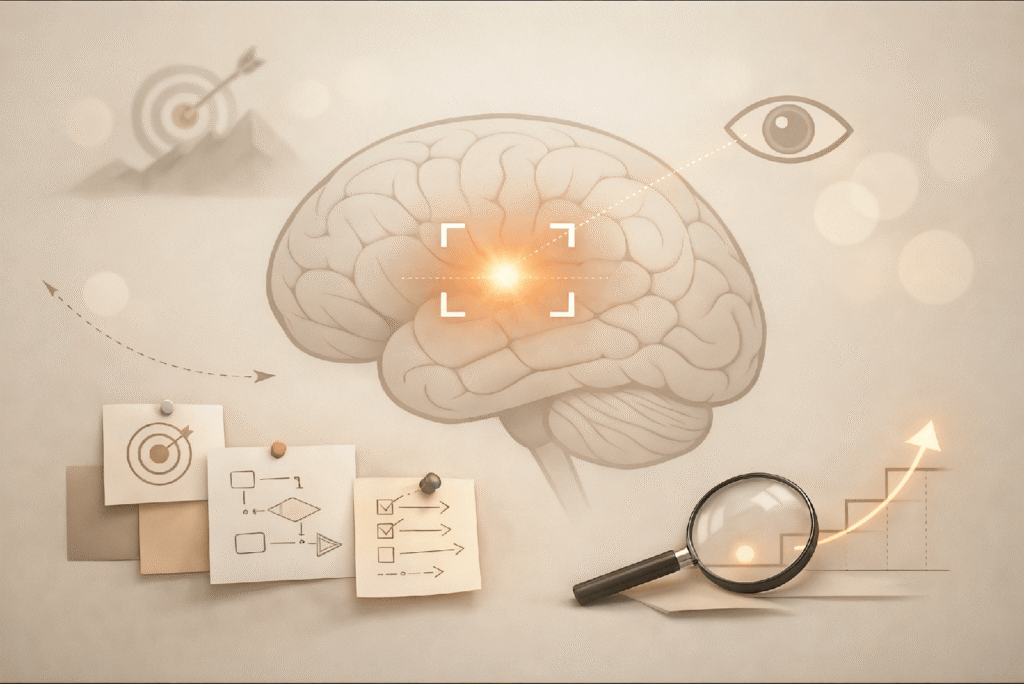
While the Law of Attraction is nonsense as physics, there is real neuroscience that explains why certain types of visualization genuinely work.
Your Brain Can’t Fully Tell the Difference
In 1995, the same year John Assaraf cut out that dream house photo, a neuroscientist named Alvaro Pascual-Leone at Harvard Medical School ran a study that would fundamentally change our understanding of the brain.
He took volunteers and divided them into groups. One group physically practiced a five-finger piano exercise for two hours a day over five days. The other group sat in front of the piano and only mentally practiced, imagining their fingers moving through the same exercise, without ever touching the keys.
Using transcranial magnetic stimulation, Pascual-Leone mapped changes in the motor cortex, the part of the brain that controls finger movements.
The result was extraordinary. Mental practice, he wrote, “resulted in a similar reorganization” of the brain as physical practice. The motor cortex region controlling the piano-playing fingers expanded comparably in both groups. And after just five minutes of actual physical practice at the end, the mental-only group caught up to the day-five performance level of the group that had been physically practicing all week. My friend’s wife, who’s a piano player, found this study genuinely unsettling when I showed it to her. The idea that someone could mentally rehearse and nearly match her five days of real practice in just a few minutes felt almost unfair.
Your brain changes its structure based on what you imagine, not just what you do.
In 2004, a researcher named Giorgio Ganis used fMRI brain imaging to show that approximately two-thirds of the brain regions activated during visual perception are also activated during visual mental imagery. When you vividly picture something, your visual cortex lights up almost as if you’re seeing it for real.
This isn’t metaphysics. This is measurable neuroscience. And it has real implications for vision boards.
Value-Tagging: The Real Mechanism
Dr. Tara Swart, a neuroscientist who coaches executives at companies like Samsung, KPMG, LinkedIn, and MIT Sloan, offers what might be the most scientifically grounded explanation for why vision boards can work.
It comes down to something called value-tagging.
Your brain processes roughly eleven million bits of sensory data every second. But you can only consciously process about fifty. So your brain has to constantly decide: what’s important? What gets through the filter?
When you repeatedly look at images representing your goals, your brain starts to assign higher importance, or higher value, to information related to those goals. You’re essentially training your attention system to flag relevant opportunities, resources, and connections that you would have otherwise filtered out.
It’s related to what some people call the Reticular Activating System, or the Baader-Meinhof phenomenon, that experience where you buy a red car and suddenly see red cars everywhere. They were always there. Your brain just wasn’t tagging them as important.
A caveat here: while the RAS is a real neurological structure involved in attention and arousal, and while value-tagging is a real cognitive process, the direct claim that vision boards “reprogram your RAS” specifically is popular science extrapolation, not something that’s been directly tested in a peer-reviewed study. I want to be honest about that.
But the broader principle, that repeated visual exposure to goal-related imagery changes what your brain pays attention to, is well-supported by attention and perception research.
The Critical Distinction: Process vs. Outcome
This might be the single most important finding for anyone who wants to use vision boards effectively.
In 1999, psychologists Lien Pham and Shelley Taylor at UCLA ran an elegant study on college freshmen before a midterm exam.
They split students into two groups. One group was told to visualize getting a high grade, which is the outcome. Imagine seeing that A on your paper. Feel the pride.
The other group was told to visualize the process of studying. Picture yourself sitting down, opening the textbook, working through the material.
Both groups visualized for five to seven days before the exam.
The results were decisive. The process visualization group studied more, started earlier, and got better grades. The effect was driven by two mechanisms: better planning and reduced anxiety.
The outcome visualization group? No improvement.
Let that sink in. Visualizing success, the thing most vision boards are designed for, didn’t help. Visualizing the work required for success, the thing almost no vision boards include, did.
This study is the Rosetta Stone for understanding what a vision board should actually be.
What a Vision Board Is Really For
So now we have all the pieces. And we can finally answer the question.
A vision board is not a magic manifesting machine. It’s not a letter to the universe. It’s not a shortcut around hard work.
A vision board, when used correctly, is a goal-clarification and attention-priming tool.
Here’s what that means and why it matters.
Function #1: Forcing Goal Specificity
One of the most robust findings in all of psychology is Locke and Latham’s goal-setting theory: specific, challenging goals lead to higher performance than vague goals. As their meta-analyses published in Current Directions in Psychological Science confirm, this has been validated across more than 88 different tasks, with over 40,000 participants, in multiple countries, over decades of research.
The simple act of making a vision board forces you to answer a question most people never ask: What do I actually want?
Not “I want to be successful.” Not “I want to be happy.” But: what does the life I want actually look like? What job am I doing? Where am I living? What does my morning look like? What am I spending my time on?
Most people have never sat down and gotten genuinely specific about their goals. The process of searching for images, choosing them, arranging them, that process forces specificity. And specificity is where motivation starts.
Dr. Tchiki Davis from the Berkeley Well-Being Institute puts it well. She acknowledges that vision boards are “somewhat controversial in the scientific community” because of their association with the Law of Attraction. But, she says, “given we know that the very act of setting goals is better than not setting goals, vision boards are indeed likely to be a useful tool, at least for some people.”
Function #2: Attention Priming
Once you’ve clarified your goals and created visual representations of them, repeated exposure trains your brain to notice relevant information. This is the value-tagging mechanism discussed above.
You put a photo of a publishing deal on your board, and suddenly you notice a writing workshop in your neighborhood. You didn’t manifest the workshop. It was always there. But your brain is now tagging it as important because it matches a goal you’ve explicitly defined and visually encoded.
This is subtle but powerful. In a world where we’re drowning in information and opportunities, having a trained attention filter isn’t mysticism. It’s a cognitive advantage.
Function #3: Self-Efficacy Building
Albert Bandura, the Stanford psychologist who developed self-efficacy theory, showed that your belief in your ability to achieve something is one of the strongest predictors of whether you’ll actually try, and whether you’ll persist when things get hard.
In 2013, psychologist James Maddux proposed that “imaginal experiences,” meaning successfully accomplishing a task in your mind, should be considered a source of self-efficacy. When you see yourself surrounded by images of your goals, it can strengthen your belief that those goals are achievable. Not because the universe is rearranging itself, but because your self-image is expanding to include those possibilities.
Bandura himself said it clearly: “Unless people believe they can produce desired effects through their actions, they have little incentive to undertake activities or persevere in the face of difficulties.”
Function #4: Emotional Clarification
This is the function that gets the least attention but might be the most valuable.
A Psychology Today article on art therapy and vision boards made the point that the therapeutic value of a vision board lies in the process rather than the final product. The act of selecting images reveals your values, priorities, and desires, sometimes in ways that surprise you.
Burton and Lent published a paper in 2016 in the Journal of Creativity in Mental Health aligning vision boards with solution-focused therapy. The American Counseling Association has since published guidance on integrating vision boards into cognitive behavioral therapy, person-centered therapy, trauma-informed therapy, and group therapy settings.
When a therapist uses a vision board with a client, the point isn’t to “manifest” anything. The point is to externalize internal desires and create a tangible starting point for conversation, self-awareness, and planning.
What an Evidence-Based Vision Board Actually Looks Like
Given everything above, the evidence-based vision board looks quite different from the stereotypical one.

Neil Farber, a physician and psychologist who literally wrote a book called Throw Away Your Vision Board, advocates replacing vision boards with what he calls “Action Boards.” Tara Swart uses the same term.
The difference? An action board doesn’t just show the destination. It shows the route.
Instead of only having a photo of a beach house, you also include images representing the steps: the side hustle that funds the down payment, the financial advisor you need to call, the savings target broken into monthly chunks.
Instead of only picturing the marathon finish line, you include the 5 AM alarm clock, the training schedule, the foam roller.
This is where Oettingen’s research comes full circle. She developed a framework called WOOP, which stands for Wish, Outcome, Obstacle, Plan, based on her mental contrasting research. You imagine the positive outcome, yes. But then you immediately identify the key obstacle, and you create an if-then plan for dealing with it.
When vision boards incorporate this, combining goal plus obstacle plus plan, they transform from passive fantasies into active strategic tools. And that’s the version that works.
The Famous Vision Board Stories, Reexamined
Let’s go back to those famous stories with fresh eyes.
Jim Carrey’s Check
In 1985, Jim Carrey was a broke, 23-year-old comedian. He wrote himself a check for ten million dollars, made it out for “acting services rendered,” post-dated it to Thanksgiving 1995, and kept it in his wallet. He would drive to Mulholland Drive in Hollywood after performing at comedy clubs and sit in his car visualizing directors who admired his work.
Just before Thanksgiving 1995, he learned he would earn ten million dollars for Dumb and Dumber.
It’s a fantastic story. And it’s real. Carrey has told it on Oprah, on The Graham Norton Show, in multiple interviews.
But notice what Carrey himself says about it. When Oprah said “Visualization works if you work hard,” Carrey’s response was: “Well, yeah. That’s the thing, you can’t just visualize and then go eat a sandwich.”
Between 1985 and 1995, Carrey worked relentlessly. He performed at comedy clubs, took small acting roles, did In Living Color, built his career brick by brick for a decade. The check was a goal-clarification tool and a self-efficacy booster. But it was the decade of grinding work that made the check cashable.
Carrey also later said something that gets far less airtime: “I think everybody should get rich and famous and do everything they ever dreamed of, so they can see that it’s not the answer.”
John Assaraf’s House
Assaraf’s dream house story is legitimately remarkable. But Assaraf himself, on his own website, has consistently emphasized the action component. He writes: “While it all starts with an idea and a crystal clear picture of what you want, you can’t just sit around visualizing and waiting for things to happen… Unless you get off your butt and do something, it’s not realistic to expect that much will happen.”
He explicitly calls out that the “Law of Attraction cannot work effectively unless you also follow the Law of Action.”
Katy Perry’s Childhood Vision Board
In 1993, nine-year-old Katy Perry was in fourth grade when her teacher asked the class to make a vision board. Perry chose a photo of Selena Quintanilla holding her Grammy Award, since Selena had just won that year.
Fifteen years later, Perry was nominated for her first Grammy.
It’s a charming story. But what happened in those fifteen years? Voice lessons, songwriting, a failed first album, changing her name, getting dropped by a label, starting over. The vision board planted the seed. The work grew the tree.
The Pattern
Every famous vision board success story, when you examine it closely, follows the same pattern: clarify the goal, plus do an enormous amount of work, plus have the board serve as a recurring reminder.
Not a single one of these people sat on a couch and stared at their board until a check appeared in the mail.
How to Actually Use a Vision Board (Based on the Research)
If you want to make a vision board that actually works, based on the neuroscience, the psychology, and the research covered throughout this article, here’s what the evidence supports.
Get specific about what you want. Not “abundance.” Not “success.” Specific outcomes with timelines. Locke and Latham’s research is unambiguous: vague goals produce vague results.
Include the process, not just the outcome. For every aspirational image on your board, include something that represents the work required to get there. The Pham and Taylor study is clear: process visualization drives action. Outcome-only visualization doesn’t.
Identify obstacles. Oettingen’s WOOP framework works. After you imagine the positive outcome, think about what’s most likely to stand in your way, and make a plan for it. You can even put those obstacles on the board. An honest board is more useful than a pretty one.
Look at it regularly, then do something. The value-tagging mechanism requires repeated exposure. But looking isn’t the end. It’s the beginning. Every time you look at your board, it should prompt a question: What am I doing today to move toward this?
Review and update. Goals change. You change. A vision board isn’t a tattoo. The act of periodically reviewing and updating your board is itself a valuable goal-reassessment exercise.
Don’t confuse feeling good with making progress. This is Oettingen’s core warning. If your vision board makes you feel like you’ve already arrived, it’s working against you. The board should create a productive tension between where you are and where you want to be, not dissolve that tension through fantasy. I remember my cousin telling me once that she spent an entire January building the most beautiful vision board she’d ever made, and by March she realized she hadn’t taken a single real step toward any of it. That stuck with me.
So What Is a Vision Board Really For?
It’s not a cosmic ordering system. It’s not a letter to the universe. And despite what a $300-million franchise told us, it’s not a secret at all.
A vision board is a mirror. It reflects back to you what you actually want, sometimes revealing desires and priorities you hadn’t fully articulated, even to yourself. And then, if you build it right, it serves as a daily prompt to do something about it.
The neuroscience is real: your brain changes in response to what you visualize. Attention is trainable. Self-efficacy can be built through imaginal experience.
But none of that works without the part that isn’t photogenic enough to make it onto a poster board: the daily, unglamorous, sometimes boring action of moving toward your goals one step at a time.
Jim Carrey said it. John Assaraf said it. Even Oprah said it.
You can’t just visualize and go eat a sandwich.
Put the sandwich down. Look at your board. And get to work.